

Securing a position within the Federal Investigation Agency (FIA) is a highly competitive and sought-after career path in Pakistan. The recruitment process for administrative and clerical roles—such as Assistant, Stenotypist, Upper Division Clerk (UDC), and Lower Division Clerk (LDC)—is rigorously structured to test candidates on both general aptitude and job-specific knowledge.
To ensure transparency and handle large volumes of applicants efficiently, the FIA partners with the Virtual University of Pakistan (VU) to conduct its Computer-Based Tests (CBT) Test. Understanding the precise syllabus and exam criteria is the first step toward achieving a high score.
Post-Wise Test Criteria Overview
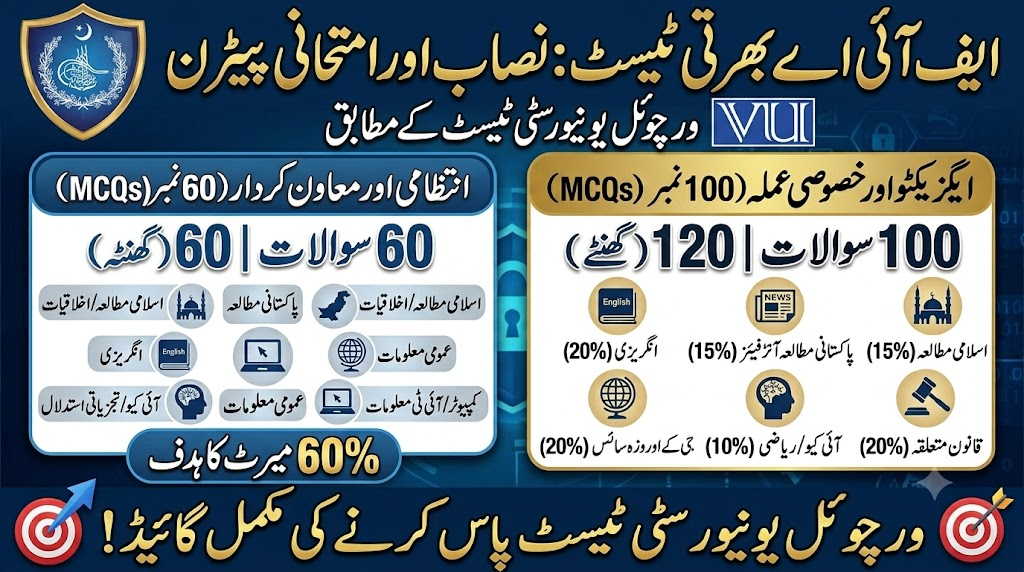
Based on the official recruitment criteria, the written examination for the primary administrative posts consists of a highly standardized multiple-choice question (MCQ) format.
- Total Questions: 60 MCQs
- Test Duration: 60 Minutes (1 hour)
- Test Type: MCQs Based (Computer-Based Test conducted by Virtual University)
The distribution of questions is identical across all four major scales, though the minimum academic qualification requirement varies by rank:
| Sr. No. | Post / Category | Total Questions | Duration | Test Type |
| 1 | Assistant | 60 | 60 mins | MCQs Based |
| 2 | Stenotypist | 60 | 60 mins | MCQs Based |
| 3 | UDC | 60 | 60 mins | MCQs Based |
| 4 | LDC | 60 | 60 mins | MCQs Based |
| 5 | Staff Car Driver | 60 | 60 mins | MCQs Based |
Subject-Wise Syllabus Breakdown
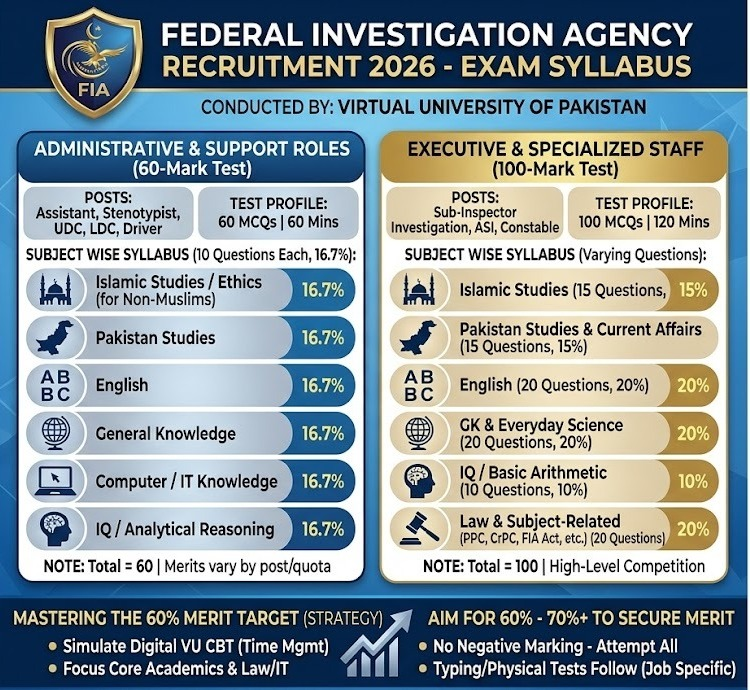
Each 60-question paper is divided equally into six core subject areas. Candidates are required to attempt 10 questions per subject, with no negative marking.
1. Islamic Studies / Ethics (10 Questions)
This section tests the candidate’s basic knowledge of Islam. For non-Muslim candidates, an alternative paper on Ethics is provided.
- Basic Islamic history and tenets (Beliefs, Pillars of Islam)
- Life of the Prophet Muhammad (PBUH)
- Rightly Guided Caliphs (Khulafa-e-Rashideen)
- Quranic basics and fundamental Islamic terminology
2. Pakistan Studies (10 Questions)
Focuses on the historical, political, and geographical foundations of Pakistan.
- History of the subcontinent from 1857 onwards (Aligarh Movement, Pakistan Resolution)
- Key historical figures (Quaid-e-Azam, Allama Iqbal, Sir Syed Ahmed Khan)
- Geography of Pakistan, natural resources, and basic constitutional milestones
3. English (10 Questions)
Designed to evaluate basic communication and comprehension skills, which are vital for office correspondence.
- English Grammar usage (tenses, prepositions, parts of speech)
- Vocabulary (synonyms and antonyms)
- Sentence structuring and error detection
- Reading comprehension
4. General Knowledge (10 Questions)
Tests general awareness of both national and international events.
- Current Affairs (recent national and international developments)
- Basic geography, capitals, and currencies of the world
- Important international organizations (UN, OIC, SAARC)
- Everyday Science (solar system, basic biology, and major scientific inventions)
5. Computer / IT Knowledge (10 Questions)
Crucial for clerical and administrative roles, as these jobs require daily computer usage.
- Fundamentals of computer hardware and software
- Basic Microsoft Office proficiency (MS Word, Excel, PowerPoint)
- Operating system basics (Windows functions, file management)
- Basic networking, internet usage, and cybersecurity awareness
6. IQ / Analytical Reasoning (10 Questions)
Evaluates problem-solving abilities, logical thinking, and mental agility.
- Number series and alphabetical sequence puzzles
- Blood relation and directional reasoning problems
- Basic arithmetic, percentages, ratios, and averages
Also Read More About: FIA Sub Inspector Jobs Test Preparation
2. Executive, Operational, and Specialized Field Staff
- Total Questions: 100 MCQs
- Test Duration: 50 Minutes
- Test Type: MCQs Based (Computer-Based Test conducted by Virtual University)
| Sr. No. | Post / Category | Total Questions | Duration | Test Type |
| 1 | Sub-Inspector Investigation | 50 | 50 mins | MCQs Based |
| 2 | ASI (Assistant Sub-Inspector) | 50 | 50 mins | MCQs Based |
| 3 | Constable | 50 | 50 mins | MCQs Based |
Preparation Strategy for Virtual University CBT
Since the Virtual University administers these tests via computer, candidates need to be prepared for a digital testing environment.
- Practice Computer-Based MCQs: Since you will be taking the test on a screen, practice online mock exams to build your time management skills. You only have one minute per question, so pacing is critical.
- Brush up on MS Office: Clerical posts (UDC/LDC) and Stenotypists frequently have practical typing tests following the written exam. Ensure your typing speed meets the official criteria (usually 30+ words per minute), alongside preparing for theoretical computer questions.
- Focus on Core Grammar and Basic Arithmetic: A significant portion of candidates lose marks in the English and IQ sections. Daily practice of basic math formulas and grammar rules will yield easy points.
- ASI Test Preparation Mcqs Base Test
- FIA Assistant (BS-15) Test Preparation
- LDC ASI Test Preparation Mcqs Base Test
Merit Marks for FIA 2026 Recruitment [ Expected ]
To successfully clear the Federal Investigation Agency (FIA) recruitment process conducted by the Virtual University of Pakistan, candidates must aim for a score well beyond the traditional 40-50% passing threshold, targeting 60% to 70%+ to secure a spot on the highly competitive merit list. Whether you are taking the 60-question test for administrative roles (such as Assistant, Stenotypist, UDC, LDC, or Driver) or the 100-question test for executive field positions (like Sub-Inspector, ASI, or Constable), achieving this benchmark requires a solid grasp of core academics—including English, General Knowledge, Pakistan Studies, Islamiyat, IT skills, and basic arithmetic—alongside job-specific knowledge like legal frameworks (PPC/CrPC) for investigation staff. Since there is no negative marking in the computer-based test, candidates should optimize their time management, attempt all questions, and leverage high mock-test scores to confidently advance through the subsequent skill, physical, or interview stages.

2 thoughts on “FIA Recruitment Test Syllabus and Exam Pattern (Virtual University)”